You Won’t Believe What I Found in Santiago de Cuba’s Hidden Streets
Walking through Santiago de Cuba felt like stepping into a living museum. The city’s architecture isn’t just old—it’s alive, breathing history with every painted balcony and weathered wall. I didn’t expect to fall in love with crumbling colonial facades or pastel-colored buildings singing with Caribbean soul, but I did. This is more than sightseeing—it’s a conversation with time, culture, and resilience written in stone, steel, and vibrant paint. In a country where every city tells a story, Santiago speaks in a dialect of its own: bold, rhythmic, and unfiltered. Here, beauty doesn’t hide behind restoration or polish. It reveals itself in cracked stucco, in laundry strung between balconies, in the laughter spilling from open courtyards. This is a place where architecture isn’t preserved behind glass—it lives, evolves, and endures.
First Impressions: A City That Feels Like a Memory
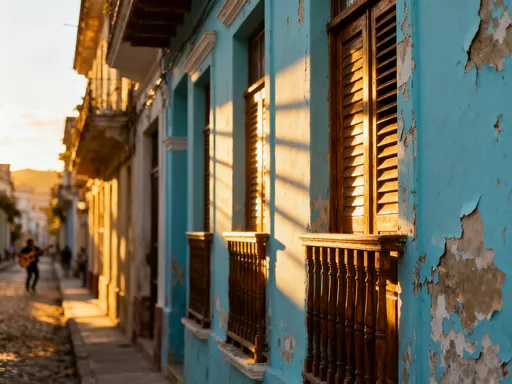
Arriving in Santiago de Cuba is an immersion. The heat wraps around you like a second skin, the air thick with the scent of ripe mango, diesel, and salt from the nearby Caribbean Sea. The city unfolds along steep hills, its streets cascading downward like folded fabric, each layer revealing another shade of faded grandeur. Unlike Havana, where restoration projects have polished certain neighborhoods into postcard-perfect scenes, Santiago feels raw and real. There’s no attempt to hide the passage of time. Instead, it’s celebrated—in the peeling paint, the rusted iron railings, the wooden shutters held together by ingenuity and hope.
What struck me most was the absence of architectural uniformity. You won’t find rows of identical colonial buildings here. Santiago’s streets are a patchwork of styles—Spanish colonial, neoclassical, Art Deco, and Creole—layered over centuries, each building telling a different chapter of the city’s story. Some houses stand tall with ornate cornices and grand doorways; others lean slightly, their foundations settling into the hillside like elders easing into chairs. This is not a city frozen in time, but one that has aged with character, adapting to each new decade with quiet determination.
Compared to Trinidad, where tourism has carefully curated the colonial aesthetic, Santiago feels less staged, more lived-in. There’s a sense that life here unfolds on its own terms. Children play in fountains, vendors call out from street corners, and music drifts from open windows, often live and unplanned. The city doesn’t perform for visitors—it simply exists, inviting you to walk its uneven cobblestones and discover its secrets at your own pace. This authenticity is what makes Santiago unforgettable: it doesn’t ask to be admired. It asks to be felt.
The Heartbeat of Creole Architecture
Santiago’s architectural soul lies in its Creole style—locally known as *arquitectura criolla*. This is not a textbook style taught in European academies, but one born of necessity, climate, and cultural fusion. Wooden structures dominate the residential neighborhoods, their frames raised slightly off the ground to protect against humidity and flooding. Wide, overhanging roofs shield the walls from torrential rains, while steep pitches allow quick water runoff. Balconies extend like open arms, inviting the breeze and offering residents a front-row seat to the daily rhythm of the street.
The use of wood is both practical and expressive. In a tropical climate where stone retains heat, wood breathes. It expands and contracts with the seasons, aging gracefully rather than crumbling under pressure. Many of these homes were built in the 18th and 19th centuries by skilled Afro-Cuban and Spanish craftsmen who combined European techniques with Caribbean sensibilities. The result is a style that is light, airy, and deeply connected to its environment. You can see it in the latticework of the windows, the hand-carved railings, and the rhythmic spacing of the columns that line the porches.
Neighborhoods like Casas de Teja and San Juan Hill are living archives of this tradition. In Casas de Teja, the rooftops are still covered with the original clay tiles—hence the name, which means 'houses of tile.' These homes, though modest, carry a quiet dignity. Their facades are often painted in soft yellows, blues, or pinks, colors that reflect the sunlight rather than absorb it. In San Juan Hill, the architecture climbs the slope with determination, each house perched on stilts or built into the rock. Here, the balconies are larger, sometimes doubling as outdoor living rooms where families gather in the evenings. This is architecture shaped not by architects, but by people who know how to live well in a challenging climate.
Colonial Bones, Caribbean Soul: Spanish Influence Reimagined
The Spanish colonial legacy is deeply embedded in Santiago’s urban fabric, but it has been thoroughly reinterpreted through a Caribbean lens. Founded in 1515, Santiago was one of the earliest Spanish settlements in Cuba, and its public buildings reflect that long history. The Catedral de Nuestra Señora de la Asunción stands as a prime example—a structure that began as a modest church in the 16th century and evolved over centuries into a complex of domes, arches, and bell towers. Its thick stone walls and symmetrical layout speak of European order, but its bright yellow facade and open courtyard feel distinctly Caribbean.
What makes colonial architecture in Santiago different from that in Spain or even mainland Latin America is its adaptation to tropical life. The Spanish brought their grid-based city planning and religious grandeur, but they had to adjust to the heat, humidity, and frequent storms. Buildings were modified with high ceilings to allow hot air to rise, thick walls to insulate interiors, and large windows and doors to encourage cross-ventilation. Patios became essential—not just for aesthetics, but for cooling. These inner courtyards, often tiled and shaded by banana or palm trees, serve as the heart of the home, where cooking, washing, and socializing take place.
Elevated foundations are another key adaptation. Many colonial-era buildings in Santiago sit on stone or brick plinths, lifting them above flood-prone areas and allowing air to circulate beneath the floors. This simple innovation prevents rot and keeps interiors drier during the rainy season. Even churches and government buildings incorporate these features, proving that survival often trumps style in a place where nature is always present. The Catedral’s interior, cool and dimly lit, offers relief from the midday sun, while its exterior, painted in warm ochres and whites, reflects the light rather than absorbing it. This blend of form and function is what gives Santiago’s colonial architecture its enduring relevance.
Survival in Style: How Buildings Adapted Over Time
The 20th century brought profound changes to Cuba, and Santiago’s architecture bears the marks of economic shifts, political isolation, and resource scarcity. Yet, rather than decline, the city’s buildings have demonstrated remarkable resilience. What might look like decay to an outsider is often a testament to adaptation. With limited access to imported materials and professional construction services, residents have become masters of improvisation. Patchwork repairs are common—sections of wall replaced with concrete blocks, mismatched bricks, or even repurposed shipping pallets. Metal roofs, often made from corrugated galvanized steel, have replaced traditional tiles in many areas, not for aesthetic reasons, but because they are more readily available and easier to install.
One of the most striking examples of architectural adaptation is the transformation of large colonial mansions into multi-family dwellings. In wealthier times, these homes housed single families with servants and staff. Today, they are often divided into several units, each occupied by a different family. Walls are added, staircases modified, and courtyards partitioned, but the original structure remains intact. Some of these buildings now operate as *casas particulares*—private homestays that offer travelers a chance to experience Cuban hospitality firsthand. Staying in one feels like stepping into a living history lesson, where the past and present coexist in a delicate balance.
The ingenuity of Santiago’s residents is evident in the smallest details. Doors are reinforced with scrap metal, windows are fitted with handmade grilles, and plumbing is rerouted using whatever pipes are available. These solutions are not temporary fixes—they are long-term strategies for maintaining shelter and dignity in difficult circumstances. There’s a quiet pride in these repairs, a sense that even when resources are scarce, beauty and function can still coexist. This is not a city waiting to be saved by outside intervention. It is a city that has already saved itself, one brick, one beam, one coat of paint at a time.
Color as Identity: The Emotional Language of Paint
In a place where paint is expensive and often in short supply, the decision to coat a building in bright turquoise, fuchsia, or sunflower yellow is never trivial. In Santiago, color is not decoration—it is declaration. It speaks of identity, resistance, and joy in the face of hardship. Walking through Barrio Vista Alegre, I was struck by how every house seemed to have its own personality, expressed through its palette. One home wore a coat of coral with mint green trim, another stood in royal blue with golden accents. Even buildings with crumbling facades were painted with care, as if the act of choosing a color was an act of hope.
This tradition of vibrant color predates the economic challenges of recent decades. Historically, Cuban cities were painted in bold hues to combat the glare of tropical sunlight and to create visual interest in dense urban environments. But in Santiago, color has taken on deeper meaning. It reflects personal expression in a society where individuality is often shaped by collective experience. A woman painting her house pink isn’t just making an aesthetic choice—she’s asserting her presence, her taste, her right to beauty. Children grow up surrounded by this chromatic richness, and it shapes their sense of place and possibility.
There’s also a communal aspect to color. In some neighborhoods, families coordinate their paint choices, creating harmonious blocks that feel like open-air galleries. In others, the contrast is deliberate—a yellow house next to a purple one, a green door on a red wall. These choices create visual rhythm, turning the streets into dynamic compositions. For travelers, this chromatic vitality is one of Santiago’s most enchanting features. It invites you to look closer, to notice details, to appreciate the artistry in everyday life. More than any museum or monument, the painted houses of Santiago tell the story of a people who refuse to let hardship dull their spirit.
Beyond the Facade: Inside the Homes of Santiago
Gaining entry to a private home in Santiago is a rare and generous act. With permission, I had the privilege of stepping inside several residences, each offering a glimpse into the intimate world of Cuban family life. What surprised me most was the contrast between the elaborate exteriors and the modest interiors. While the outside might be painted in dazzling colors with ornate railings, the inside is often simple, even sparse. Furniture is functional—wooden tables, metal bed frames, hand-me-down sofas covered in bright fabric. Walls are plain, sometimes cracked, with family photos and religious images tacked directly to the plaster.
The courtyard, however, is where the home truly comes alive. More than just a design feature, it is the social and functional heart of the house. Here, meals are prepared on gas stoves or charcoal grills, laundry is hung to dry, and neighbors stop by for coffee or conversation. In one home, I watched a grandmother teach her granddaughter how to make *moros y cristianos*—black beans and rice—over an open flame in the patio. The scent of garlic and cumin filled the air, mingling with the sound of a radio playing son music from the 1950s. These spaces are not just practical; they are sacred, fostering connection and continuity across generations.
Materials inside are often repurposed. Flooring might be salvaged wood or cracked tile, windows are repaired with tape or cardboard, and lighting is minimal. Yet, there is a sense of care in every corner. Plants in recycled bottles line the steps, handmade curtains filter the sunlight, and children’s drawings are proudly displayed. This is not poverty—it is resourcefulness. It is a way of living that values relationships over possessions, creativity over convenience. To be invited into such a space is to witness the true meaning of home: not perfection, but presence.
Preservation or Progress? The Future of Santiago’s Urban Landscape
The future of Santiago’s architecture hangs in a delicate balance between preservation and progress. On one hand, there are growing efforts to restore historic buildings, particularly in the city center. The Cuban government, in partnership with international organizations, has launched initiatives to stabilize facades, repair roofs, and reinforce foundations. Skilled artisans—masons, carpenters, painters—are being trained to maintain traditional techniques. These projects are vital, not just for tourism, but for the safety and dignity of residents who live in aging structures.
Yet, funding remains limited, and skilled labor is in short supply. Many restoration projects move slowly, delayed by bureaucracy and material shortages. In some cases, modern construction methods are introduced—concrete blocks, steel frames, synthetic paints—that clash with the historic fabric of the city. There is tension between the desire for modernization and the need to preserve authenticity. Some residents welcome new materials for their durability and lower cost, while others worry that the soul of the city is being lost in the process.
Urban planning in Santiago faces difficult choices. Should historic neighborhoods be preserved as open-air museums, or should they evolve with the needs of contemporary life? Can new construction respect the scale and style of the old without becoming pastiche? These questions have no easy answers. What is clear is that any solution must involve the people who live there. Top-down interventions risk erasing the very character that makes Santiago special. Sustainable preservation must be community-driven, respecting both heritage and humanity.
Conclusion: Architecture That Speaks Without Words
Santiago de Cuba’s buildings do not whisper—they sing. They sing of survival, of creativity, of a people who have turned limitation into language. Every cracked wall, every hand-painted door, every courtyard filled with music tells a story that no guidebook can fully capture. This is not a city of perfect monuments, but of living history—imperfect, vibrant, and deeply human.
To walk through Santiago is to listen. To notice how a balcony curves just so to catch the evening breeze, how a child’s drawing is taped to a wall like a masterpiece, how a family shares a meal under the stars in a space that has witnessed generations. Travel, at its best, is not about ticking off landmarks. It is about connection—between places and people, past and present, beauty and truth.
The architecture of Santiago does not demand admiration. It asks for attention. It reminds us that true resilience is not the absence of decay, but the courage to keep creating, to keep coloring, to keep living—no matter the odds. In a world that often values newness over depth, Santiago stands as a quiet rebellion. Its streets say, without words: We are still here. And we are beautiful.